
Product Requirements:
Device:
HP 1900 series iPAQ Pocket PC
I remember the first “armored” case that I ever purchased – a titanium
Ti Slider
by Rhinoskin. At the time I was traveling extensively and carried my old
Handspring Visor Ice Deluxe with me in a pack or in a jacket pocket. At the
time, several years ago, I read a review of the Ti Slider by Julie and was
immediately sold. No matter where I was or what I was carrying, I could rest
assured that my Ti Slider was protecting my Visor and its precious contents from
every scrape, bump, and knock. Though it was boxy looking, I still miss that old
Ti case with its gorgeous titanium patina and industrial look.
Several weeks ago, as I was packing up the family for vacation to Maine, I
received an Innopocket Metal Deluxe Case for my wife’s
iPAQ 1910 to review.
Thankfully the professional looking plastic casing was not the type that
requires heavy-duty shears and protective gear to cut through. Rather, the front
of the packaging opened easily and provided access to the case. No cuts to have
stitched up at the last minute at the ER! I slipped the iPAQ into the case, then
into my old Tumi T2 backpack.
I had recently taken ownership of a new Microsoft Tanager/SPVx SmartPhone and
wished to bring along another PDA as a backup. We were planning on spending over
a week hiking, biking, climbing, “lobstering” and kayaking around the wilds of
Acadia National Park. I then had an urgent business trip overseas. On both trips
I found the case to be a blessing. Having just returned, I felt compelled to
share my experience with the it. I forgot how much I loved the protection
provided by a good metal PDA case.
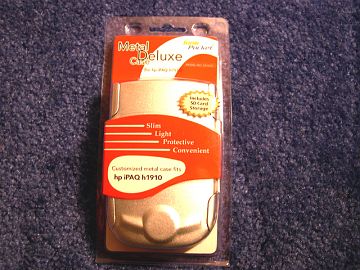
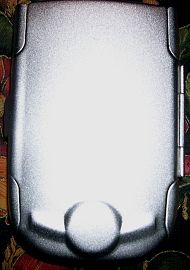
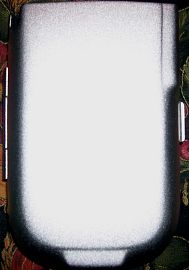
The case is anodized aircraft aluminum. The anodized color is silver, and there
is a nice texture to the finish. This texture not only provides a decent grip
(even with moist hands from hiking) but also helps to hide fingerprints. The
aluminum construction is quite sturdy yet lightweight. I tried Julie’s squeeze
test on the case and it didn’t squeak, though it isn’t as stiff and resilient as
titanium. All the gaps are uniformly tight with no puckers. The case closely
mimics the case profile of the 1910, and includes a “bump” on the front of the
case over the directional pad and the application keys. The back of the case is
contoured around the iPAQ. The features, from the back of the packaging:
- Anodized aluminum protects your hp iPAQ Pocket PC h1910 handled from wear and
tear - Precision molded case to perfectly fit your handheld
- Neoprene lining holds your handheld securely in place and protects it
against drops, shocks and collisions - Cutouts give easy access to stylus, memory slot, headphone jack, IR port,
record button and charging/synchronization port - Size: 116x80x21mm
- Weight: approximately 70g
- Model Number: C9-0311
- Made in China
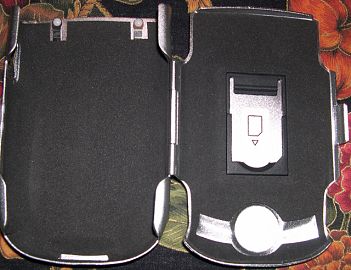
The case opens to the left, which I found a bit odd at first (I’m ambidextrous).
However, I found myself becoming accustomed to it quickly. The interior of the
case is covered in neoprene, which provides shock protection should the iPAQ and
case be dropped. One nice detail is the SD/MMC card storage slot located under
the cover of the case. I’ve become accustomed to traveling with more than one SD
card, typically one for apps and one for MP3s/WMAs/MPEGs. I never noticed the
card touching the screen, unlike some of the leather cases with built-in SD/MMC
cards I’ve owned for other iPAQs. The finishing details were exquisite. The
neoprene was fitted without a ripple, and there wasn’t a rough edge on the case
(unlike some of the earlier aluminum PDA cases). Unlike the Ti Slider, which
used friction between the neoprene and the Visor to hold the PDA in place, this
Innopocket case uses two thin aluminum arms with small plastic beads on their
ends to apply pressure to the back of the iPAQ. These arms and beads align with
two dimples on the back of the 1910. With the iPAQ inserted into the case, I was
unable to “accidentally” shake the unit out its aluminum cocoon (though I must
admit I did not shake the case too violently).
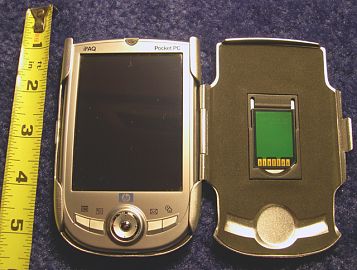
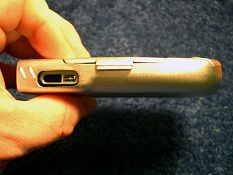
The sides of the case provide well located cutouts for all the ports and buttons
on this little wonder of a PDA. On the left side there is a cutout for the IR
port and the record button. Though the record button is recessed behind the
case, the button is still accessible and less prone to accidental button
presses. However, the reset hole is blocked. On the
right side is a cutout to ease access to the stylus.
The bottom provides access to the charge/synch port. My charge and synch cable
worked flawlessly, but I doubt the PDA could be placed into the charge/synch
cradle when enclosed in the case (unfortunately, I do not have such a cradle to
test this). The top of the case is open, so accessing the
SD/MMC card or headphone jack is painless.
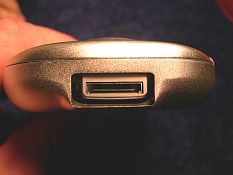
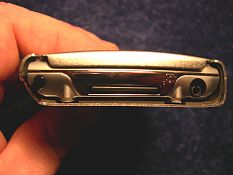
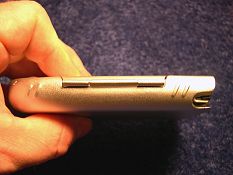
My biggest concern about using a metal case on the slim and attractive 1910 was
the typical bulkiness and lack of attention to details that I’ve experienced in
the past. However, this case has reset all of my expectations surrounding metal
PDA cases. It only marginally increased the size and weight of this lithe little
PDA, yet afforded it a level of protection that cannot be equaled. I was amazed
at the cutouts provided, and how well they aligned with the many ports and
buttons on the 1910. Even with my stubby fingers I was able to access the
buttons. Amazing.
I carried the PDA/case combination with me everywhere we went. It fit well into
the interior pockets of my trusty old Scott eVest 2.0 alongside my new Tanager.
It spent hours at a time in a pack sharing space with bottles, snacks, and some
climbing gear in my backpack. It even traveled through security and across the
Atlantic Ocean and back inside of my eVest. I used the spare SD/MMC card slot to
house a card dedicated to storing the images captured by my Tanager’s snap-on
digital camera. There isn’t a scratch or dent on the case, and the 1910 is happy
and secure in its new home.
The only real wish that I have for the case is some type of provision for a belt
clip. Perhaps a threaded port on the back of the case for a screw-on style clip
would be possible? In this manner it wouldn’t damage the slim form factor of the
case during those times the clip wasn’t in use. Though I typically carry my PDA
in a pocket in a jacket or bag, there are times that a clip on case could come
in handy.
In summary, I was pleasantly surprised by the fit and finish of this case, and
the high levels of protection it affords my (wife’s) beloved 1910. Whether on
board a ship, hiking in the mist and fog on Cadillac Mountain, or strolling
through Hyde Park in London, the 1910 never left its case when in use. Now that
I’m back on home turf, my wife has taken custody of the wonderful 1910 and will
not even consider removing it from the Innopocket case. Until Louis Vuitton,
Orbino, or someone else creates such a stylish and protective case solution for
PDAs, this Innopocket Metal Deluxe Case has found a home in my wife’s purse.
That alone speaks volumes about its style and substance!
Price: $29.90 available at
Innopocket
Pros:
Lightweight, yet highly protective case
Well built (with no sharp edges) with access to most ports and buttons
Textured finish makes it less slip-prone than other anodized finishes
Simply gorgeous
Cons:
Lack of a belt clip
Gerber Gear 22-47162N Fast Draw Folding Assisted Opening Pocket Knife, Fine Edge, Black
(as of June 12, 2026 18:40 GMT -05:00 - More infoProduct prices and availability are accurate as of the date/time indicated and are subject to change. Any price and availability information displayed on [relevant Amazon Site(s), as applicable] at the time of purchase will apply to the purchase of this product.)
Gerber Gear EVO Jr. Folding Knife - Serrated Edge [22-41493]
(as of June 12, 2026 18:39 GMT -05:00 - More infoProduct prices and availability are accurate as of the date/time indicated and are subject to change. Any price and availability information displayed on [relevant Amazon Site(s), as applicable] at the time of purchase will apply to the purchase of this product.)Product Information
| Price: | 29.9 |
| Manufacturer: | Innopocket |
| Pros: |
|
| Cons: |
|

Gadgeteer Comment Policy - Please read before commenting
Post your comments here on the Innopocket Aluminum PDA Case Reviews.
Tungsten C Case
Toshiba e740 Case
Zire 71
HP 2215
HP 1910
Just click the POST REPLY button on this page.[
Finally, a hard case for the C! Can you do some testing to see if the case interferes with the WiFi signal?
Thanks for your great reviews, as always!
When I got my Innopocket I had to bend the cover slightly to even get the case to open it was sealed shut so tight. Also, the metal on the top left of the case is overlapping some. But for the money this is a great case. I can throw it in my pocket or my laptop bag and don’t have to worry about it getting damaged.
Even though I like the Innopocket case, I think now that Vaja has an Ivolution for the T|C I’m going to move up to that. You may see my metal case on ebay soon 🙂
I couldn’t put up with having to remove the PDA from the case to charge it. Synching isn’t a problem because I can do that over WiFi. Why don’t the case makers think about the cradle/charger issue? Or perhaps they do and have decided that it’s too difficult to get around and we just have to take the thing out every time. Now if Palm etc. made a charger like the one on my Panasonic shaver then that would be good. The shaver uses induction to charge the batteries so it just needs to fit into a coil with no plugs or connectors. Palm, are you listening?
I returned the case for a serveral of reasons. One is using the thumboard is impossible to do while balancing the case in your hands. Two, the case is two slipper and would drop easily.Lastly I couldn’t us the 3-1 innopocket sync /charge/sd card cable I purchased. You need to the and the back of the TC open to use teh cable.
🙁
Has anyone noticed any affect on the WiFi performance of the T|C when its in a metal case? I’d expect them to shield the antenna and reduce the range, but I don’t know how noticable that is.
The title of the site should be
“The Gageteer with tones of PDA Case Reviews”
Aie.
The way that the SD card pins are exposed when inserted into the case makes me ancy.
Two questions about the Innopocket Zire 71 case:
When the SD card slots are full, do they touch the screen and run the risk of scratching it?
Does the snug fitting case run the risk of scratching the finish on the Zire 71 when removed from the case?
Yeah, I’m a little bit of a scratchphobe if you haven’t noticed.. 😮 Nice review by the way!
Although I didn’t write the Zire 71 case review, I’m going to respond to this message. Innopocket styled their cases in such a way that the cover is usually bowed out. This allows the SD card / cards to NOT touch the screen whe the cover is closed.
As for the cases scratching the PDA from repeated insertion and removal, that should also not be a problem as long as the neoprene lining is still in place. The lining is soft and spongy, and will not marr the finish on your PDA. <- At least it never has on any of my PDAs so far.
Thanks for the speedy reply Julie! I’m happy to hear there no scratch related risks with the case. Now, if only they could make a metal case that opened/closed like a flip cover… then I’d be in heaven. 🙂
Hi,
I had bought a Innopocket case for my e750 via web. Once I opened up my package, I was amazed on how attactive it looked.
And surely felt solid once I opened it. I quickly put my PDA in it but once I got in, I discovered that it was tough to get it out!
I played with it for an hour or two, finally I had found out a sure way to get it out for my e750 Innopocket case. Perhaps someone already knew this, but I could not find it anywhere in the web. So let me voice this out.
The problem of not getting out, is the clips that lock the PDA, where there are 2 holds at the back of the e750. So I insert a screen protector, see attached image, so it helps to pass down at least one of the clips. And slightly push with a stylus toward the opening of the case at the bottom of the PDA and it will slide out easily. I have not tried it, but a credit card should work as well.
Only now that I got my unit out and found the clips does stretch a little of the back of my PDA.
BUY THIS CASE!! :love: They DO protect your PDA as promised!
I have a Zire 71 and purchased this cases bretheren from iConcepts which is the exact same case. I recently found out Innopocket, iConcepts, and Rhino Skin all have a version of this case.
I does fit to the exact measurements of the PDA and the neoprene protects nicely. The SD are reverse because of the “short factor” of the contacts meeting with the metal casing. (Although they could have lined the interior so you can turn them around and actually SEE which cards are which. :rolleyes: )
The case IS slippery and as a result, when I got out of my car this morning, it slipped from my hand as I was adjusting a small FedEx package I needed to send. I watched in horror as it flew from my hand tumbling sideways end-over-end towards the parking garage concrete. (complete with slow motion “N-o-o-o-o-o-oooooo..”:eek: ) WHAM!! as it landed on a corner and slid a bit. I nausiatedly reached for it expecting a case full of pieces when EUREKA!! Not a scratch!! Powered it up and it was perfect. Even better was the hardcase did not fly open on impact risking the screen!! WOW! I am very impressed with this case now and will purchase them for every PDA I ever own from now on!!