
Before I begin this review, I will state for the record that I
realize I am not your mother; it is not my job to judge you or your
drinking habits. So with that said…
Assuming that one is above the legal drinking age, I think that
it is perfectly acceptable to enjoy a few drinks with friends in
each other’s homes, and I can understand wanting to blow off steam
after a hard day’s work by going out and having a couple beers with
the gang. I would never think less of a friend for having “a few
too many” while playing cards or watching a game, and I know for a
fact that live music really does sound better once I’ve had
a drink. But because I am a mom, I have to say that when the
end of the evening rolls around and someone I know is acting like
they may have had a little bit too much to drink, the only
correct choice to be made is whether I should drive them home or
call a cab. The one thing that none of us should ever have to live
with is the guilt of knowing that we might have been able to do
something to stop someone we cared about from driving while
intoxicated.
Driving While Intoxicated, or DWI as it is
commonly called, appears to be a huge problem in Texas. I
don’t know if it is just because our state is so big or because
Texans are a bunch of boozehounds, but – no pun intended – the
statistics are sobering. According to a
report published by the National Highway Traffic Safety
Administration, in the year 2004 there were 3,583 people killed
in alcohol-related crashes in Texas, the second highest death rate
in the country behind California. Of the 3,583 alcohol-related
crash fatalities in Texas, 41% that died had been drinking;
59% had not been drinking at all. In other words,
people that drive under the influence are not just putting
themselves in danger, they are a menace to innocent drivers
and passengers.
In the United States, a Blood Alcohol
Content, or BAC, of 0.08 is considered legally drunk.
Wikipedia
defines BAC as the “concentration of alcohol in blood, measured by
volume, as a percentage.” As an example, Wikipedia states that
having a 0.20 BAC would therefore mean that one part per 500 in an
individual’s blood was alcohol. Interestingly enough, drawing blood
is not the only way to measure for BAC. According to the aptly
named website, R U PISSED,
“Alcohol that a person drinks shows up in the breath because it
gets absorbed from the mouth, throat, stomach and intestines into
the bloodstream. Alcohol is not digested upon absorption or
chemically changed in the bloodstream. As the blood goes through
the lungs, a physiologically predictable amount of the alcohol will
moves across the lung membranes and into the lungs themselves. Once
in contact with the air in the lungs, it evaporates and is exhaled.
The concentration of the alcohol in the air in the lungs is
directly related to the concentration of the alcohol in the blood.
The ratio of breath alcohol to blood alcohol is 2,100 to 1 (and
called the partition ratio), so the alcohol content of 2,100
milliliters of exhaled air will be the same as for 1 milliliter of
blood. The maths are simple from there and leads to blood alcohol
readings expressed as a percentage of alcohol in the blood.” So in
other words, with the proper type of measurement device, it is
possible to determine someone’s Blood Alcohol Content by the air
that they exhale.
If a person has been drinking and they are pulled over for any
reason, a chain of events are set in motion that are almost
impossible to stop. Most people have heard of the “Breathalyzer
Test” that police will sometimes perform on those suspected of
driving under the influence of alcohol. Although these breath tests
are generally not admissible in court, they are a very valuable
tool when used by law enforcement to determine a person’s degree of
impairment. While there are no criminal sanctions in the
State of Texas for refusing to submit to a breath test, there are
other serious repercussions.
I spoke with my good friend Grabb, a deputy with the Tom Green
County Sheriff’s Department today, to ask about what happens when
someone is pulled over and the officer suspects a possible DWI. I’m
talking about a simple traffic stop, that doesn’t involve any
accident or harrowing drama. In San Angelo, if an officer suspects
that the person they have pulled over has been drinking and the
subject refuses to submit a breath test, the result is a guaranteed
arrest for DWI and a trip to jail. During the arrest, the officer
will confiscate the suspect’s driver’s license.
After several hours of sitting and waiting at the jail, in order
to leave a bond of $500 or more must be posted. While the defendant
is posting bond and getting their court date, the DPS will begin
the process of revoking their driver’s license. If this is the
driver’s only drug or alcohol offence in the last ten years, their
license will automatically be suspended for 90 days. If a person’s
record shows any other drug or alcohol related enforcement
contact during the previous ten years, their license will
automatically be suspended for a year. Remember, this is just for
refusing to take the breath test – no formal charges have
yet been filed and the person has not been found guilty of
anything.
If the person’s license is suspended and they have to be able to
drive in order to work, an occupational license is available for
first time offenders. The privilege of getting this special license
is a surcharge of $3,000, broken into three yearly payments of
$1000.
A court date will be set, and should the defendant be found
guilty they will owe the $320 court fee. On top of the court and
bond fees, DPS/State of Texas surcharges, the towing of the
vehicle, the probationary costs, the community service hours, the
MADD review board humiliation, the psychological evaluation, the
additional auto insurance fees, the possible job loss, and the
stigma of having one’s name posted in the local paper, if a lawyer
is retained there will be additional fees of around $5,000.
I had no idea…!
I was also surprised to learn that even though 0.08 is the legal
limit, that number isn’t always firm. If an officer pulls a driver
over for a possible DWI and the suspect submits to a breath test,
blowing above a 0.01 but below a 0.08, they can still be
arrested for DWI if the officer believes that the vehicle operator
is impaired to a point where he is a danger to himself or the
public.
All of this misery, embarrassment and expense can be avoided by
never drinking and driving…and yet people still do it.
Many of them are average, otherwise respectable people – moms,
dads, neighbors and bosses. I suspect that quite a few are under
the impression that even after a few drinks and a slight buzz, they
will be “fine to drive” because there is no way that they
could possibly be drunk, because they don’t do that
sort of thing. These people don’t understand that as few as two or three drinks
in an hour can put them over the legal limit, and that the
tipsy feeling they are enjoying is an indication of their
impairment. They might even be insulted if told that they shouldn’t
drive because they had had too much to drink; but if you could
show them that they had had too much, these same people
would probably be horrified to realize that they had even
contemplated driving.
Those are the people that I think would most be influenced by a
product such as the one I will be talking about today, one of the
Q3 Innovations AlcoHAWK Series
of alcohol testing devices. Q3 Innovations offers five different
models of AlcoHAWKs, for this review I was sent the AlcoHAWK Slim.
Included in the standard package are the AlcoHAWK Slim, gift box,
mesh carrying bag, three mouthpieces, owner’s manual, quick start
guide, and a one-year warranty. The device needs two AA batteries,
which are not included.
Specifications:
| Dimensions | 5 x 1.75 x .75 inches (L*W*H) |
| Weight | 0.3 lbs |
| Housing | Shock Resistant, Molded Plastic |
| Batteries | Two (2) AA Alkaline Batteries |
| Battery Life | 150-300 tests |
| Sensor | Sensitive Semiconductor Sensor |
| Warm-Up Time | 30-45 Seconds |
| Blowing Time | 5 Seconds |
| Response Time | 5 Seconds |
| B.A.C. Range | .00 – .40% BAC (Blood Alcohol Concentration) |
| Air Sample | 5 Seconds |
| Sensor Accuracy | +/- 0.01% at 0.02% B.A.C. |
| Calibration | Calibrated by Q3 Innovations, LLC |
| Operation | Single Button |
| Warranty | 1 Year |
Measuring approximately 5″ tall x 1.75″ wide x 0.75″ thick, the
device weighs only 3.6 ounces and is easily pocketable. Although
the AlcoHAWK Slim is composed of silver plastic and it doesn’t
weigh very much, in hand it feels solid enough. The case does not
flex or creak when torqued and squeezed, and there is just a slight
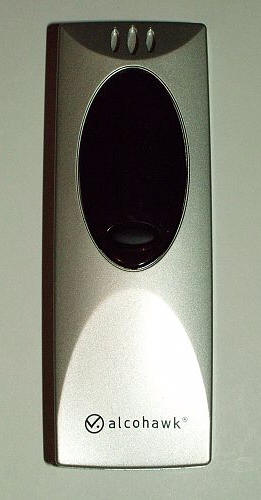
interior rattle when it is shaken. Three air vents are located on
the top front edge, directly above a semi-opaque black plastic
window covering the three character red LCD display. Under the
display is a lone black button.
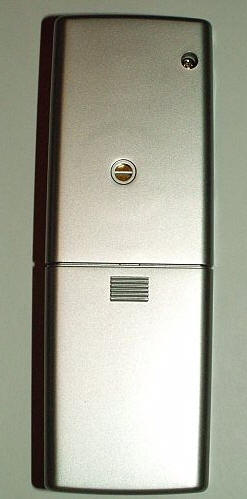
The back has a single tone speaker and the battery
compartment.
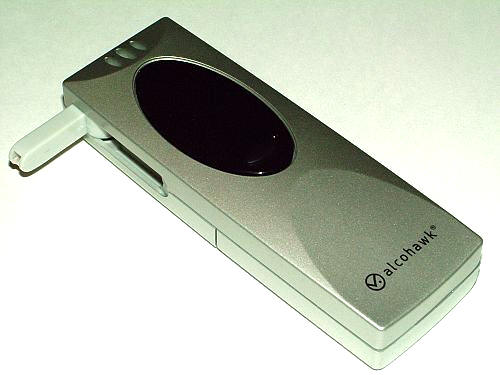
A folding mouthpiece on the left side of the device flips up,
ready for the user’s lips.
According to the AlcoHAWK’s user manual, “The device contains a
sensor chip designed to test for the presence of alcohol. A thick
film heater is printed on the reverse of the chip placed in the
plastic housing. The metal oxide material is heated to a specific
temperature. The resistance of sensing material changes rapidly
according to gas concentration changes, thereby enabling the
reading of alcohol concentration by resistance measurement. This
alcohol concentration is directly related to the concentration of
alcohol in the blood. Therefore this device can give a reading that
reflects an estimate of the concentration of alcohol in the
blood.”
Getting a reading from the AlcoHAWK is relatively simple…
If the device hasn’t been used in over 24 hours, then the sensor
should be primed by blowing into the mouthpiece for four or five
seconds and then turning on the device. One should always wait at
least 20 minutes after smoking, eating or drinking before using the
tester. According to the manual. “failure to do so can alter the
BAC reading and damage the sensor.”
Pressing the button on the front of the device initiates a sixty
second countdown readying the interior components for the upcoming
test breath.
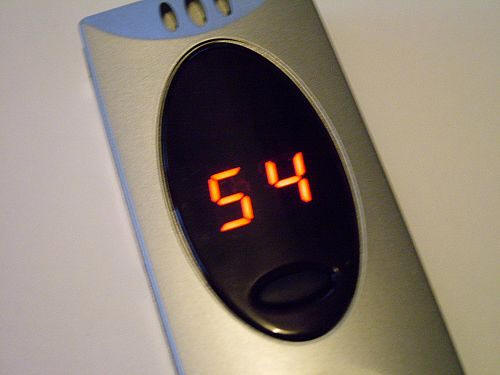
The unit is ready when a beep sounds and a solidly glowing
decimal point is displayed.
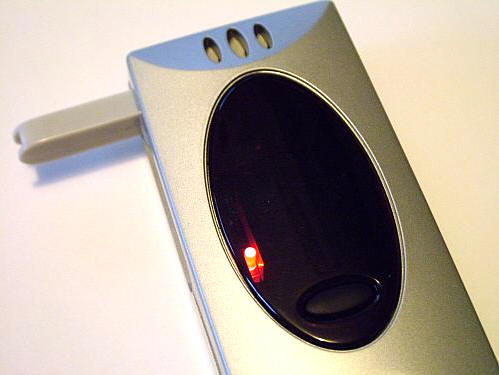
Once the beep is heard and the decimal is displayed, the user
should “take a deep breath and blow steadily (for at least five
seconds) until a beep sounds to signal completion of the testing.
As can be seen here, I am blowing a 0.00.
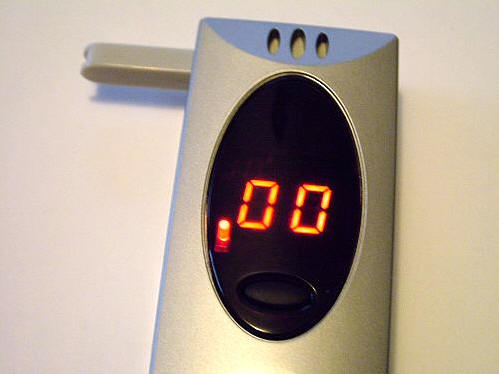
I am obviously safe to drive at the moment.
During the Basketball playoffs, one of my good friends came over
to watch the Florida vs. George Mason game with Steve and me. I
made buffalo chicken wings and potato salad, and she brought two
bottles of wine. Over the next four or so hours we ate, drank, and
watched as Florida did their thing. When it was all over Florida
had won, the chicken and potato salad were gone, and she and I had
finished the two bottles of wine. Even though we had spread our
drinking over several hours and even though we were not drinking on
empty stomachs I was still feeling a little light headed. Well no
wonder, because according to the AlcoHAWK my BAC was 0.03.
According to the AlcoHAWK manual, at 0.03 BAC, there is
“generally no loss of coordination, slight euphoria or loss of
shyness,” and the “depressant effects [of alcohol] are not
apparent.” Interestingly enough, I was also feeling some of the
next level of intoxication’s symptoms, including relaxation and the
sensation of warmth.
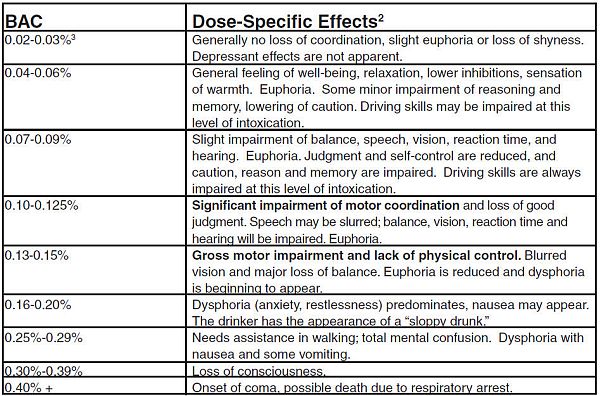
²Bailey, William J., Drug Use in
American Society, 3rd ed., Minneapolis: Burgess, 1993.
³Some individuals may experience
impairment at BAC levels of 0.03% or even lower.
For those that wonder at what BAC level it is “safe to drive”,
here is a helpful chart…
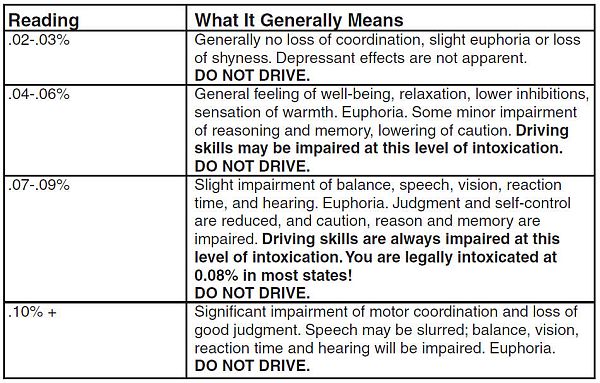
Well, it looks like if you are going to drink at all,
then you shouldn’t drive at all. But then, we already knew
that, right?!
In my opinion, the desired effect of using this device would be
that the person tested could see that they were blowing an alcohol
reading period, and that driving in their present
condition would not be a good idea.
Even though the AlcoHAWK’s manual includes the warning to not
“use this device as a tool to determine whether you or anyone else
should operate any motor vehicle or machinery,” the fact is that
there will be those that use it the justification for their
supposed sobriety. These will be the people that drink a couple of
beers in 30 minutes, blow a 0.04 and then stumble to their car
confident that they are totally fine. I doubt that this or
any type device would have the desired effect on that particular
type person.
Of course, if someone thinks that they had better test their BAC
to make sure that they are “okay” to drive, then in my
opinion they have no business driving. If I feel the need to test a
boy before he takes my daughter on a date, then he is not someone
that I would want dating my daughter. If one of the workers at the
ranch gave me reason to believe that I should test him before
allowing him to drive a ranch vehicle, then it would be time to
reconsider his employment. If I felt the need to test my daughter
after she came home from a friend’s party, then it would be time
for me to reconsider my daughter’s and my communication as well as
her choice of friends.
I guess in an ideal world, it wouldn’t take an $80 device to
remind people that they have no business driving after they’ve been
drinking. But if an $80 device is able to accomplish what thousands
of dollars in fines, mandatory community service and social stigma
can’t, then I would consider it money well spent.
Click here to
read the owner’s manual online.


Gadgeteer Comment Policy - Please read before commenting
I really can’t stand self-righteous people who say that if we drink AT ALL that we shouldn’t be driving.
Speak for yourself. If I have one drink I am fine to drive, and there is nothing wrong with using something like the Alcohawk to make sure that I won’t be going to jail.
You say that it might give people a FALSE sense of security about driving. Well, that may be true in some cases. However, if I was the one using it, I wouldn’t be using it to see whether I’m capable of driving ok or not, I would simply be using it to check and make sure I’m not going to have any legal issues with dirving.
That is the whole point of owning one! I completely disagree that drinking AT ALL means one should not be driving.